
A garage door jammed mid-travel leaves your home completely vulnerable to weather elements, coastal wind gusts, and property theft. When an overhead door stops at the halfway point, the counterbalance system remains under extreme tension while gravity exerts downward force on the suspended door sections. At Expo Garage Doors Long Island, we receive emergency service dispatches daily across Brookhaven Township—from Stony Brook and Port Jefferson down to Shirley, Patchogue, and Eastport.
If your residential or commercial garage door is stuck halfway open right now, execute these critical safety steps immediately before attempting any troubleshooting:
-
Stop Using the Remote or Wall Console: Repeatedly pressing the door opener button forces the electric motor to pull against a mechanical jam. This can strip internal nylon drive gears, snap lift cables, or burn out the logic board circuit.
-
Keep Clear of the Opening: Never walk, stand, or park a vehicle under a door suspended in mid-air. An unbalanced 150 to 400-pound garage door can drop unexpectedly if a cable snaps or a roller slips out of the track.
-
Do NOT Pull the Emergency Red Release Cord: Pulling the manual disconnect cord while the door is elevated detaches the door panel from the opener trolley. If a spring is broken or unspooled, the entire deadweight of the door will slam shut without resistance.
-
Secure the Immediate Area: Restrain pets and inform family members to stay away from the garage space. If night is falling or severe weather is approaching in Suffolk County, move exposed valuables out of direct sight from the street if safe to do so.
-
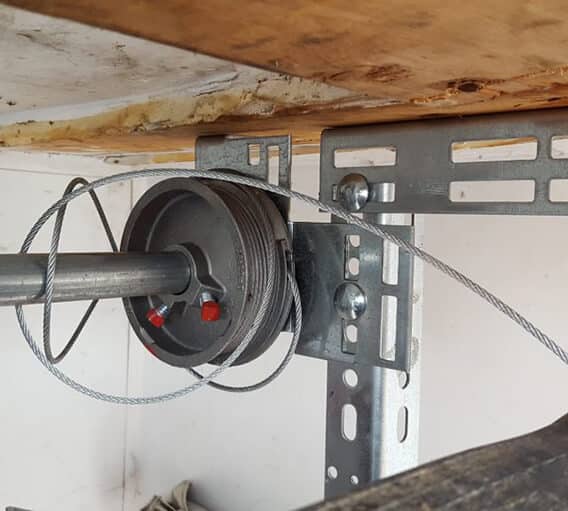
Inspect from a Safe Distance: Perform a visual audit from several feet away. Look for broken overhead springs, slack or thrown cables, crooked door panels, or loose rollers jammed inside the track.
Diagnostic Matrix: Why Overhead Doors Fail Mid-Travel
Determining the exact root cause of a mid-travel lockup requires analyzing structural, mechanical, and electrical subsystems. The matrix below outlines the primary failure modes we diagnose in Brookhaven properties:
| Symptom & Visual Indicator | Primary Mechanical / Electrical Cause | System Hazard Level | Required Professional Repair |
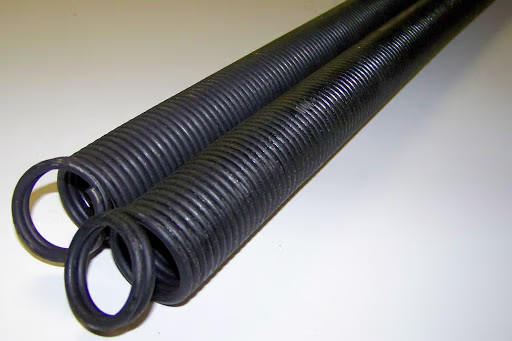
| Loud pop/bang heard; door suspended crookedly; visible gap in overhead spring coils | Torsion spring fracture or dual extension spring fatigue | Critical (High Risk of Structural Impact) | Safely un-tension system, replace matched pair torsion springs, reset drum timing |
| Door jams abruptly with metal grinding; rollers pop out of side track channel | Off-track cable jump or severely bent vertical/horizontal track | High (Door Detachment & Collapse Danger) | Lock down weight, realign track, re-thread 7×19 lift cables onto drum grooves |
| Door lowers halfway, pauses, and immediately reverses back to open | Misaligned photo-eye sensors, obstructed travel limit switch, or worn force settings | Moderate (Property Insecurity) | Recalibrate optical alignment, reset opener travel limits, inspect safety reversal system |
| Motor unit hums continuously but drive chain or belt refuses to move trolley | Stripped opener drive gear, broken trolley assembly, or seized carriage | Low to Moderate (Mechanical Drive Failure) | Replace gear and sprocket assembly or upgrade trolley carriage component |
| Door lifts 3 to 4 feet, shudders violently, and stops; cables hanging limp | Cable drum slippage, oxidized pulleys, or bottom fixture bracket failure | High (Asymmetrical Load Hazard) | Replace rusted cables, install heavy-duty bottom brackets, equalize cable tension |
Real-World Case Studies: Resolving Complex Mid-Travel Failures in Brookhaven
Handling emergency overhead door lockups requires advanced technical knowledge of load balancing, spring dynamics, and structural geometry. Below are two examples from our technician field logs in Brookhaven, NY detailing complex mid-travel failures and how we successfully resolved them.
Case 1: Asymmetrical Spring Snap on an Insulated Double-Car Door in Stony Brook
The Situation: A homeowner in Stony Brook called our emergency line when their 18×7-foot insulated steel door froze 42 inches above the garage threshold. The homeowner had attempted to force the door down manually, causing the door to rack diagonally and wedge tight against the wooden jambs.
Our Technical Diagnosis: Upon arrival, we identified that the left-side torsion spring had suffered a clean fatigue fracture. Because the system utilized a single-torsion shaft with dual springs, the right spring retained full tension while the left lost all lift capacity. When the homeowner pressed the wall button, the opener pulled unequally, tearing the top section’s operator reinforcement bracket and wedging the top-left roller outside the track track radius.
The Resolution:
-
We secured the suspended door panel using industrial C-clamps rated for 1,200 lbs anchored directly below the second-tier track rollers.
-
Using hardened steel winding bars, we safely unwound the remaining kinetic energy from the unbroken right torsion spring.
-
We realigned the jammed top section, replaced the bent track section, and installed an 18-inch heavy-gauge steel operator reinforcement plate across the top panel.
-
We replaced both old springs with high-cycle, oil-tempered torsion springs calibrated specifically for the door’s total weight (245 lbs) and drum pitch, restoring silent, perfectly balanced operation.
Case 2: Salt-Air Cable Binding & Track Distortion in Shirley
The Situation: A South Shore coastal residence in Shirley experienced a total system lockup where the garage door jammed at eye level. The door was stuck at a 15-degree tilt, exposing the home’s interior to heavy coastal rain.
Our Technical Diagnosis: The property’s proximity to the Great South Bay accelerated salt-air oxidation on the galvanized lift cables and cast-iron sheaves. A frayed strand on the left 3/32-inch lift cable caught on the cable drum groove during the opening cycle. The cable overlapped, jammed between the drum face and the end bearing plate, and pulled the entire left vertical track inward, binding the rollers.
The Resolution:
-
Our team installed heavy-duty locking pliers beneath both track sides and braced the bottom section with hydraulic lifting stands to prevent vertical movement.
-
We relieved spring tension and cut away the jammed, bird-caged lift cable.
-
We removed the corroded cast-iron sheaves and replaced the damaged system with commercial-grade 1/8-inch 7×19 stainless-steel aircraft cables resistant to marine salt corrosion.
-
We replaced the bent vertical track, upgraded all roller assemblies to 13-ball bearing nylon rollers with sealed caps, and re-leveled the door within 1/16th of an inch tolerance across the opening.
Safe Emergency Procedures vs. DIY Danger Thresholds
While basic maintenance like clearing leaf debris or wiping sensor lenses is safe for homeowners, attempting to repair a door stuck halfway open without specialized tools presents severe physical risks.
┌────────────────────────────────────────────────────────────────────────┐
│                        HOMEOWNER SAFETY CHECK                          │
├──────────────────────────────────────────────────┬─────────────────────┤
│ SAFE FOR HOMEOWNER DIY                           │ PRO REPAIR REQUIRED │
├──────────────────────────────────────────────────┼─────────────────────┤
│ Clear leaves or debris from optical sensor lenses│ Torsion/Extension   │
│ Check wall console lock-out switches             │ Spring Replacement  │
│ Replace remote control batteries                 │ Lift Cable Restringing│
│ Inspect track for visible branch/toy obstructions │ Bent Track Repair  │
│ Reset tripped electrical breaker switches        │ Off-Track Re-entry  │
└──────────────────────────────────────────────────┴─────────────────────┘
Contextual Technical Facts for Overhead Systems
-
Torsion Spring Energy: A residential torsion spring under full tension holds between 200 to 300 foot-pounds of torque. Unwinding or adjusting these components without calibrated winding bars can cause catastrophic impact injuries.
-
Structural Cable Load: Lift cables support the entire deadweight of the door section. Under dynamic operation, cable tension peaks at over 500 pounds of force per side.
-
Photo-Eye Infrared Thresholds: Modern garage door openers require an uninterrupted 5-volt DC signal between the transmitting and receiving sensor eyes. A deviation as small as 3 millimeters out of axis will trigger the auto-reverse safety protocol, stopping the door mid-cycle.
Local Environmental Factors Affecting Brookhaven Garage Door Systems
Overhead door performance in Suffolk County is heavily influenced by regional environmental conditions and municipal structural codes. Homeowners in Brookhaven face distinct environmental stressors that impact hardware longevity:
-
Coastal Humidity & Salt Corrosion: Properties located near Long Island Sound or the South Shore estuaries suffer rapid oxidation on non-galvanized springs, track brackets, and roller bearings. Salt buildup creates friction inside the track channel, causing the opener’s sensitivity threshold to trigger mid-travel reversals.
-
Freeze-Thaw Temperature Swings: Cold Long Island winters cause steel track channels to contract and grease lubrication to thicken into a gummy residue. This increased resistance causes the opener motor to detect a false obstruction, freezing the door halfway through its cycle.
-
High Wind-Load Structural Standards: Due to coastal hurricane risks, local residential building codes overseen by the Town of Brookhaven Building Department dictate specific wind-load requirements for exterior overhead doors. Reinforced strut configurations add overall weight to the door panel, requiring precision-matched torsion springs to prevent mid-travel sag.
-
Industry Safety Standards: All professional overhead door installations and safety testing protocols should strictly adhere to guidelines established by the Door & Access Systems Manufacturers Association (DASMA).
Professional Emergency Fixes by Expo Garage Doors Long Island
When your garage door is stuck halfway open, you need fast, certified local technicians who can secure your property without delay. At Expo Garage Doors Long Island, we provide 24/7 emergency repair dispatch throughout all of Brookhaven, NY.
Our mobile service units arrive fully equipped with high-cycle torsion springs, heavy-duty lift cables, replacement track sections, commercial-grade rollers, and OEM opener parts from leading manufacturers like LiftMaster, Chamberlain, Genie, and Clopay. We perform comprehensive safety audits on every job, ensuring your spring balance, cable alignment, track squareness, and photo-eye safety systems operate flawlessly before we consider the work complete.
FAQ
Is a garage door stuck half open considered an emergency repair in Brookhaven, NY?
Yes. A door stuck half open poses immediate home security risks, exposes your property to extreme weather damage, and presents a severe falling hazard if a cable or spring gives way. Professional emergency repair restores safety and structural security to your home.
Why should I never pull the emergency red release cord when the door is stuck halfway up?
Pulling the emergency release cord disconnects the door from the electric opener carriage. If the door is stuck due to a broken spring or thrown cable, the door loses its counterbalancing force and can crash down instantly under its full deadweight.
What causes a garage door to stop halfway and reverse immediately?
This issue is commonly caused by misaligned or dirty photo-eye safety sensors, a binding track channel, excessive cable slack, or overly sensitive force settings on the opener motor that interpret mechanical resistance as a physical obstruction.
How long does a professional emergency garage door repair take in Suffolk County?
Most emergency repairs—such as replacing broken torsion springs, restringing cables, or realigning off-track doors—are completed within 45 to 90 minutes once our technicians arrive on-site with a fully stocked service vehicle.
Can extreme Long Island weather cause my garage door to freeze mid-travel?
Yes. Rapid freeze-thaw cycles can freeze the bottom rubber seal to the driveway concrete, while extreme cold hardens old track lubricant, increasing mechanical friction and forcing the opener’s auto-reverse safety system to stop the door mid-cycle.